search

Sunday, 10 September 2017

Hudsonian Godwit

By mid August there was a small flock of Hudsonian Godwits feeding at Matthew's Lake. I should probably be more meticulous in my record keeping but if memory serves it was likely six or seven individuals. That seems to be pretty typical for the area - there never seems to be many more than that, at least in recent years. 

They are in various stages of moult, some birds showing more of their reddish breeding plumage particularly earlier in the summer when they first arrive here from their northern breeding range. Those are usually the birds I try to photograph although I'm happy to be able to get close enough to any bird for a decent picture.

You can see in the picture below of the two individuals how variable the plumage can be at this time of year. The bird on the right is exhibiting more of the grey winter plumage than its companion. August 13.


Thursday, 31 August 2017

Ruby-throated Hummingbird - Juvenile

 I had a couple of regular female hummingbirds frequenting my feeder this year and the occasional male. The male was a little too elusive for me to manage a decent photo. I had the best luck with this juvenile (male?) who didn't seem as bothered by the sound of my camera shutter as the adults. I can't say that I minded since the young birds look more pristine in their fresh new plumage. August 6.


Semipalmated Plover

I didn't find much to shoot on this day but this Semipalmated Plover was posing in good light as I was returning on the beach to head home. The other shorebirds it was keeping company with didn't stick around to have their picture taken. July 30.

Monday, 21 August 2017

Common Tern - Protective Parent


I was a little mystified why this bird was so agitated by my presence. As far as I knew at the time there weren't any nesting terns in the area. Then I noticed a juvenile, not in the immediate area but close enough that I guess its parent saw me as a potential threat. In recent days I've been in the same area among adults and juvies and they've been very passive. I suppose they become less protective as the young ones age and learn to fend for themselves.

Saturday, 19 August 2017

Shorebirds

This was my first day this summer taking pictures of shorebirds. I found a good variety, the most interesting of which was this lone Pectoral Sandpiper.


 There are always numerous Short-billed Dowitchers in the area. This species along with Semipalmated and Least Sandpipers and Semipalmated Plovers are probably the most common. The Least is not pictured here.


 I can't forget to mention Yellowlegs which are also very common. The bird pictured here is a Lesser Yellowlegs.

 I was treated to a spectacular sunset the best of which occurred after I made my way back to my car. I regretted not sticking around longer to capture that. July 22, Mattthew's Lake.


Sunday, 13 August 2017

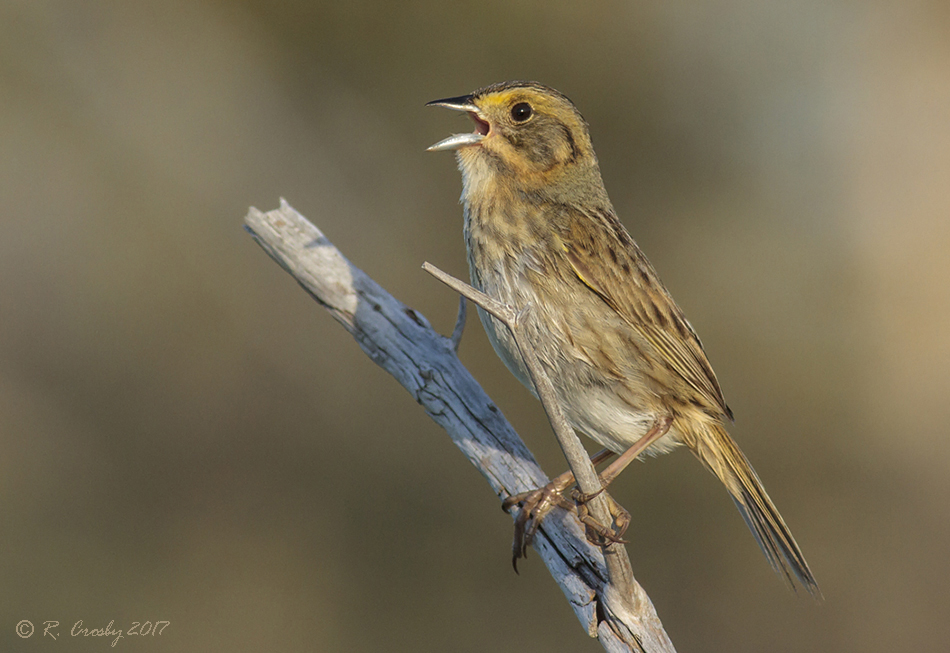
Nelson's Sharp-tailed Sparrow and Habitat

I went out specifically looking for this species on this day. They are not particularly hard to find if you know the type of habitat they prefer. Typically this bird prefers salt marshes of which there are no shortage of in the Matthew's Lake area. During the breeding season they can be seen and heard singing from the highest point around which in a lot of areas is just the top of the highest stalk of marsh grass. In this case it was from the top of a stack of driftwood piled up as a makeshift blind by duck hunters. 

To be fair to other sparrows, the song - if you can call it that,  is more of a buzz than an actual melody. When they are not singing (or buzzing) you can often find them at the edges of the many little ponds similar to the ones pictured below looking for bugs. I was treated to an interesting sky at the end of the day which I hope was part of the reward for putting up with the hordes of mosquitoes that also prefer the same habitat. July 6, Matthew's Lake.


Monday, 26 June 2017

Red-eyed Vireo


It's not hard to tell from these photos why this bird is called a Red-eyed Vireo. They are more often heard than they are seen.  This species has a reputation for singing incessantly during the breeding season even during the middle of the day when many songbirds are silent. They can be hard to see once the trees are in full foliage since their olive green plumage blends in well with their habitat. So if you hear a bird singing non-stop in the trees near where you live consider the possibility it may be this one. Many people are familiar with the song of the American Robin - vireos have a similar repetitious song. June 4, East Jordan.